You see .org at the end of charity websites, advocacy groups, and community projects everywhere online.
That pattern is not an accident. The extension carries a specific meaning that shapes how visitors judge a website before they even read a word of content.
This guide breaks down the .org domain meaning, its history, and whether it fits your own project.
What Does .org Mean?
The letters in .org stand for organization.
It was built for groups that exist around a mission, cause, or community rather than pure commercial activity.
Today, that original limit no longer applies. Anyone can register a .org domain, whether or not they run a registered nonprofit.
A Short History of .org
The .org extension launched in 1985, the same year as .com and .net, as one of the earliest top-level domains on the internet.
It was originally meant as a catch-all for groups that did not fit neatly into commercial or network categories.
Management of the extension has changed hands over the decades, and it is now overseen by the Public Interest Registry, a nonprofit organization itself, under agreements coordinated byICANN.
According to Wikipedia’s record of the .org domain, more than 10 million websites now use the extension, making it one of the most recognized endings after .com and .net.
Who Actually Uses a .org Domain?
The nonprofit association stuck around far longer than any formal rule requiring it did.
These days, .org shows up across many types of websites, including:
- Charities and non-governmental organizations
- Advocacy groups and community causes
- Open-source software projects
- Educational and research initiatives
- Professional associations and membership groups
- For-profit brands that want to signal purpose over sales
If your brand leads with mission rather than transactions, .org tends to feel like a natural fit.
Why Choose a .org Domain?
A few clear advantages explain why so many mission-driven groups reach for this extension first.
i) Instant credibility. Visitors often associate .org with trust, purpose, and sincerity before reading any content.
ii) Values-driven signal. It tells people your site is about a cause or community, not just a transaction.
iii) Better availability. Since fewer businesses compete for .org names, you often have a better chance of getting a short, clean name than you would with .com.
iv) Affordable pricing. .org domains are typically priced similarly to or lower than .com domains.
Possible Downsides to Consider
A fair look at .org also means covering its tradeoffs.
Some visitors may assume your organization is a registered nonprofit, so a commercial brand using .org should make its purpose clear elsewhere on the site.
It is also not the strongest signal for a pure e-commerce brand, where .com or a store-specific extension often communicates intent more directly.
If you are still deciding between extensions, our guide to alternatives to .com domain compares .org alongside several other strong options.
.org vs .com: A Quick Comparison
Seeing the two side by side makes the differences easier to weigh.
| Factor | .ORG | .COM |
| Meaning | Originally for organizations | Originally for commercial use |
| Best for | Nonprofits, causes, communities | Businesses, general brands |
| Recognition | High, especially for missions | Highest of any extension overall |
| Availability | Generally better | Most short names already taken |
| SEO treatment | Equal to .com | Equal to .org |
Neither extension wins across every category. The right pick depends on how you want visitors to perceive your purpose. For a deeper look at .com specifically, our guide on the .com domain meaning covers it in full.
Common Myths About .org Domains
A few outdated ideas about .org still circulate, so it helps to clear them up.
i) Myth: .org is only for registered nonprofits. This has never been a hard rule, and plenty of for-profit brands use .org for its credibility signal.
ii) Myth: .org ranks worse than .com in search results. Search engines treat every extension equally, and ranking comes down to content and backlinks instead.
iii) Myth: .org names are hard to find. In practice, .org often has better name availability than .com, since fewer commercial buyers compete for the same words.
iv) Myth: Visitors automatically distrust a commercial .org site. Most visitors judge a site by its content and design first, and a clear explanation of what you do resolves any confusion quickly.
Real Examples of .org in Action
Seeing how different groups use the extension helps make the idea concrete.
A local community food bank might use foodbanknairobi.org to signal its nonprofit mission to donors browsing for a cause to support.
An open-source software project might use the extension to show it is community-maintained rather than a commercial product.
A professional association, such as a regional teachers’ union or industry body, often chooses .org to reflect its membership-based, non-commercial structure.
Is a .org Domain Right for Your Project?
A simple way to decide is by matching your situation to what the extension signals.
Choose .org if you run a nonprofit, charity, or advocacy group that wants instant credibility with donors and supporters.
Choose .org if your project is community-driven, open-source, or educational in nature.
Consider .com instead if your primary goal is selling products or building a general commercial brand.
How Much Does a .org Domain Cost?
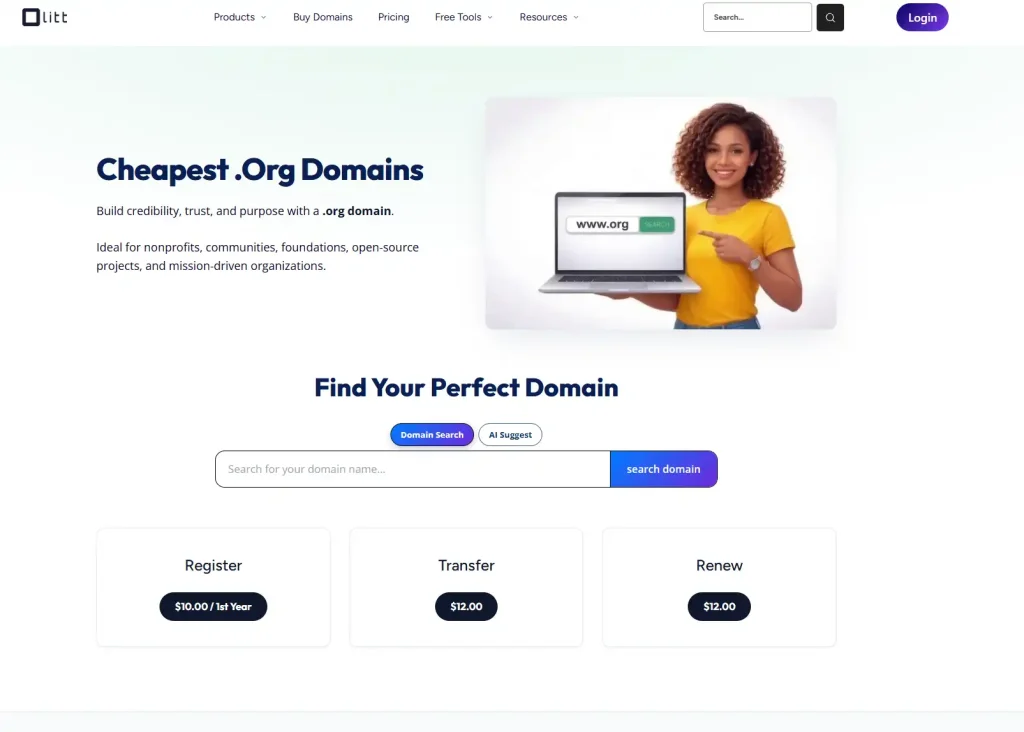
Pricing for .org domains is usually close to .com pricing, and sometimes slightly lower.
Through Olitt’s domain search tool, .org domains are available at an affordable first-year rate, with clear renewal pricing shown before you commit.
Bundling your domain with hosting or a website builder can also reduce your overall setup cost compared to buying each piece separately.
How to Register a .org Domain
Getting started takes only a few steps.
- Search your desired name through Olitt to check availability
- Compare it against other extensions if your first choice is taken
- Complete payment, and your DNS settings configure automatically
- Connect the domain to your website or hosting account
Most registrations activate within minutes, so you can move straight into building your site.
Build Your Site on Your New .org Domain
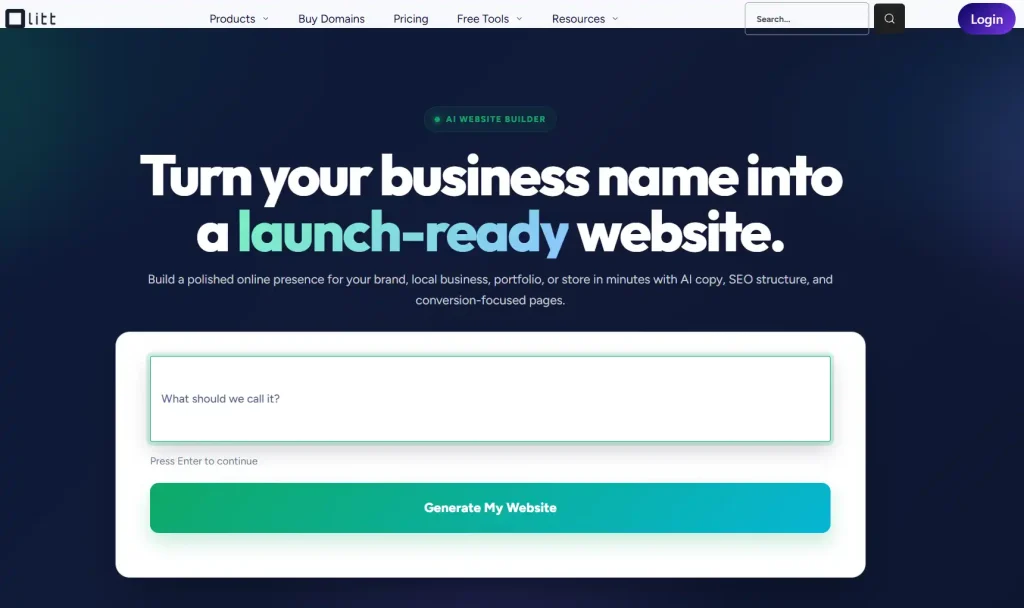
Once your domain is secured, pairing it with the Olitt AI website builder lets you describe your organization and get a working draft site within minutes.
From there, you can add your mission statement, donation tools, and program updates without touching any code.
Register Your .org Domain With Olitt
The .org domain meaning traces back to organizations and causes, and it remains one of the clearest ways to signal purpose online.
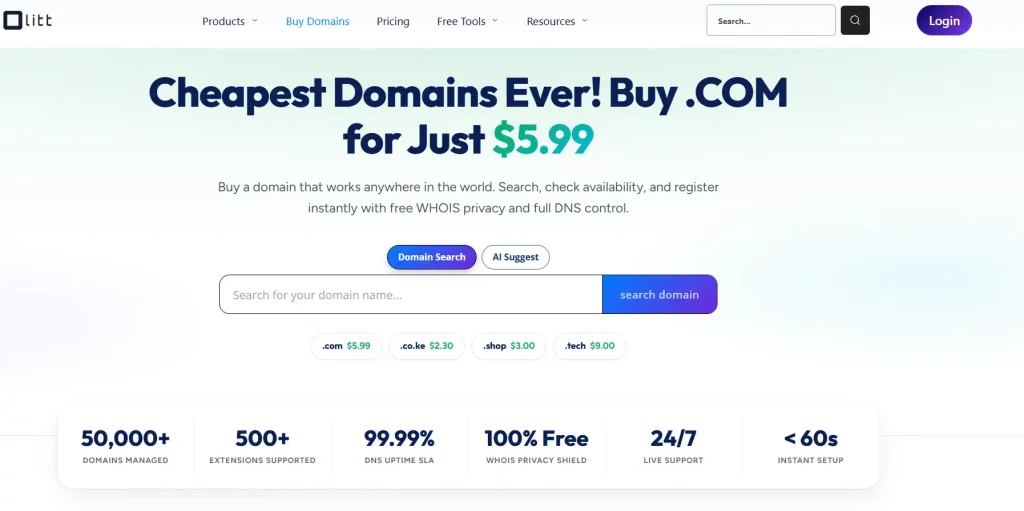
If your ideal name is available, search and register it directly through Olitt’s domain page and have it ready to connect to your website today.
Frequently Asked Questions
What does .org actually stand for?
It stands for organization, reflecting its original purpose for groups built around a mission rather than commercial activity.
Do I need to be a registered nonprofit to use .org?
No. Anyone can register a .org domain, though it is most commonly used by nonprofits, causes, and community projects.
Is a .org domain better than .com for a charity?
Generally yes, since .org signals mission and credibility more directly than a commercial extension would.
Does using .org affect my SEO?
No. Search engines treat .org the same as .com and other extensions, so ranking depends on content and backlinks, not the extension.
How much does a .org domain cost through Olitt?
Pricing is typically close to .com rates, with an affordable first-year cost and clear renewal pricing shown upfront.