Both extensions started in 1985, and they have little else in common. One tells visitors you are American, and the other tells them nothing, which is its strength.
The .us vs .com domain choice affects how people see you, how easily you find a good name, and how far your site can reach. This guide compares them on the points that decide the choice.
Cost is rarely the deciding factor. A price tracker updated on November 11, 2026 showed an average first-year .us price near $13.80 and an average renewal near $16.29.
.us vs .com Domain at a Glance
Start with this table, then read the sections that match your questions.
| Feature | .us | .com |
| Type | Country code domain for the United States | Generic domain, open worldwide |
| Who can register | People and groups with a US link | Almost anyone |
| Audience signal | The United States | None by default |
| Names registered | About two million | 166.6 million |
| Short name availability | More names still free | Most short names taken |
| Contact data | Public, no privacy service | Privacy often available |
| Best for | US-focused businesses | Global or unsure audiences |
What Is a .com Domain?
The .com extension began as a home for commercial sites. It now serves every kind of site, from stores and blogs to charities and portfolios.
Verisign runs it, and its Q2 2026 report put the .com base at 166.6 million names on June 30, 2026, according to a Verisign release. Most people type .com first when they guess an address.
What Is a .us Domain?
The .us extension is the country code domain for the United States. It is open to US citizens, permanent residents, people whose main home is in the US, US-formed organizations, and foreign groups with a real US presence.
GoDaddy Registry runs it today, and on October 1, 2026 the government chose Identity Digital to take over, according to Domain Name Wire. Our guide to US domain name requirements covers who qualifies.
.us vs .com Domain: How They Compare
Here are the five areas where the two extensions differ most.
1) Trust and Recognition
Everyone knows .com, so visitors rarely hesitate over it. A .us name is less familiar abroad, but it tells American customers that the business has a US link.
That makes .us a good fit for a neighborhood business and .com the safer pick for a brand with customers in many countries. Neither ending replaces a clear site, honest reviews, and a real address.
2) Search Visibility
Many guides say .us wins local search and .com wins everything else. The evidence is thinner than that.
John Mueller said in 2021 that a country code domain is one of two ways to target a country, and that it is not required, according to Search Engine Journal. A .com can also be geotargeted in Search Console, and nothing in that guidance says one extension outranks the other.
So a .us name gives a clean location hint, and a .com keeps your options open. Content, speed, and links decide the rest.
3) Name Availability
This is where .us has a real edge. With about two million names against 166.6 million for .com, short and clear .us names are far easier to find.
A plumber who finds smithplumbing.com taken may find smithplumbing.us free. A good .us name usually beats a long .com with hyphens, which people mistype.
Search your exact name before you decide. Availability changes by the day.
4) Eligibility and Privacy
A .com has no entry test. A .us name needs a real US link for as long as you hold it, and failing the check can mean a 30-day hold and then cancellation with no refund.
The .us registry also does not allow privacy or proxy services, so your contact details are public. With .com, privacy services are common, though they vary by registrar.
5) Reach and Growth
A .us name can read as US only, so a visitor in Kenya or Germany may assume you do not ship to them. Moving later means a rebrand, new email addresses, and a redirect plan.
A .com avoids that problem. If expansion is likely within a few years, the extra cost of a better .com name now is often cheaper than switching later.
6) Cost: What You Pay for Each
A tracker showed an average first-year .us price near $13.80, with renewals near $16.29. It also found promos as low as $0.98 in the first year.
Prices for .com vary by registrar, and premium names held by resellers can cost far more. Whatever you pick, compare the first-year price with the renewal price, since a cheap start can hide a higher second year.
Which Should You Choose?
Match your situation to this table. It is a guide, not a rule.
| Your situation | Better pick |
| A local business serving one US city or state | .us |
| A US-only store or delivery service | .us |
| A US-made brand with an American story | .us |
| A business with customers in many countries | .com |
| A startup that may expand abroad within a few years | .com |
| A brand with no US link | .com, since you would not qualify for .us |
| A business that wants WHOIS privacy | .com |
A Three-Question Test
If the table leaves you unsure, answer these in order.
- Where are your customers? If they are almost all in the US, .us is a strong candidate.
- Do you qualify? If you have no US link, the choice is made for you.
- Will you sell abroad in the next three years? If yes, lean toward .com.
What Switching Later Costs You
Changing domains after launch is possible, but it is never free. Here is what a move usually involves.
- New email addresses. Every customer, supplier, and account login tied to the old address needs an update.
- Redirects. Each old page must point to its new page, or you lose visitors and search history.
- Printed material. Business cards, signs, vehicle wraps, and flyers carry the old name.
- A dip in traffic. Search engines need time to trust the new address, so expect a slow few weeks.
- Customer confusion. Regulars may not find you at first, so announce the change in several places.
This is why the growth question carries so much weight. If there is a real chance you will serve customers abroad soon, choose the extension you would still want in five years.
Can You Own Both?
Yes, if you qualify for .us. Many businesses register both and send one to the other.
Pick one as your main address and redirect the second to it, so your site, email, and links all use one name. That protects your brand without splitting your traffic.
Owning both also stops a copycat from taking the other ending. It is not a legal shield, so register a trademark where your business needs one.
Three Examples
These are sample situations, not real businesses.
- A dentist in Denver. Her patients live within ten miles, so a .us name signals that she is local and based in the US. She skips the .com, which is taken.
- An Ohio plumber. He wins calls from nearby homeowners. He registers both extensions and redirects the .com to his .us site.
- A US startup selling software worldwide. Customers in Europe and Asia will type .com first, so the founders pay for a better .com name.
The pattern is simple. Local reach points to .us, and global reach points to .com.
Common Mistakes When Choosing
Most regrets come from a few avoidable slips.
- Choosing for looks alone. Pick for your audience first and your taste second.
- Skipping the eligibility check. A .us name you do not qualify for can be cancelled with no refund.
- Ignoring the renewal price. A cheap first year can hide a higher second year.
- Buying a long, hyphenated .com. A short .us name is often easier to say and remember.
- Forgetting to test the name aloud. If friends cannot spell it after hearing it once, keep looking.
Check Both Extensions With Olitt
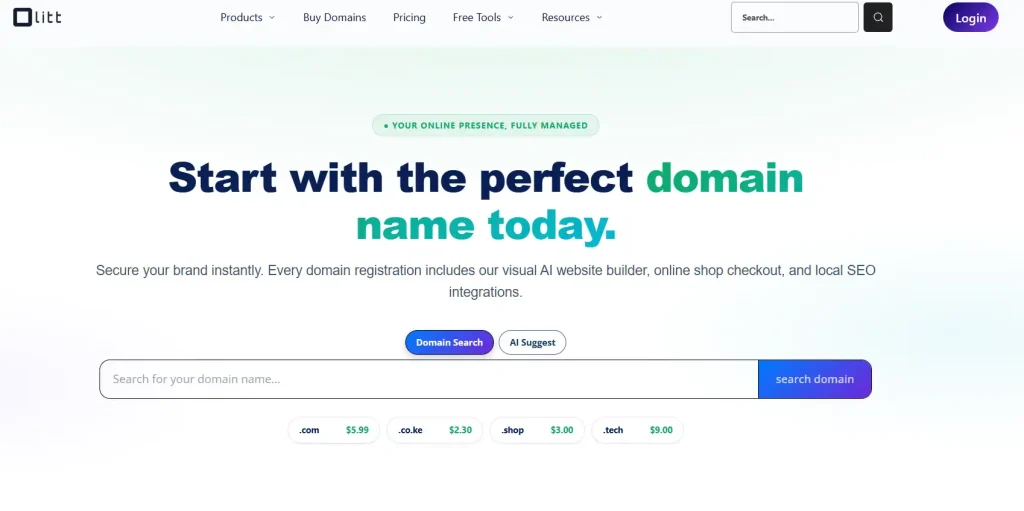
Olitt gives you domains, an AI website builder, and hosting in one account. Search your name there to see which endings are free and what they cost.
If you choose .us, follow our steps to register a .us domain. You can compare plans in the Olitt pricing section.
Frequently Asked Questions
What is the main difference between .us and .com?
A .us name is for people and groups with a US link, and a .com is open to almost anyone. A .us name feels local, and a .com feels global.
Can I register a .us domain if I live outside the US?
Only if you represent an organization with a real US office or regular lawful US activity. Everyone else should choose a .com or another open extension.
Is .com better for SEO than .us?
Not by itself. A .us name gives Google a US location hint, and a .com can be geotargeted in Search Console, so content and links decide the ranking.
Why are .com names harder to get?
The extension is old and popular, with 166.6 million registered names. Most short, simple names are taken, so you pay more or get creative.
Which extension should a local business choose?
If every customer is in the US and you qualify, .us is a good fit. If you may grow beyond the US, a .com is the safer long-term choice.
Pick Your Domain With Olitt Today
Your domain is the first thing customers see, so choose it for the audience you want. Olitt lets you search names, buy domains, and connect them to a website from one account.
Test your name on both extensions, pick the one that fits your plans, and secure it before someone else does. Then build your site and give your customers a place to find you.