.COM Domain Meaning: You see .com at the end of almost every web address, but you have probably never stopped to ask what those three letters actually mean.
Knowing the answer helps explain why this one extension became the default choice for businesses everywhere, and whether it is still the right pick for yours.
What Does .com Mean?
The letters in .com stand for commercial.
It was created as one of the first top-level domains on the early internet, specifically meant for businesses and commercial organizations.
Today, that original restriction no longer applies. Anyone, from a global brand to a personal blog, can register a .com domain.
A Short History of .com
The story starts in 1985, when symbolics.com became the very first domain ever registered under the extension.
Adoption stayed slow at first, since the internet itself was still mostly used by researchers and universities, and it was years before ICANN took shape to coordinate domain names globally.
Everything changed during the dot-com boom of the 1990s, when businesses rushed online and .com quickly became the expected ending for any serious company address, a shift well documented in Wikipedia’s history of the dot-com domain.
That early momentum never really faded. As of late 2025, over 159 million .com domains were registered worldwide, according toVerisign’s domain name industry data, making the largest extension on the internet.
Why .com Became the Default Choice
A few factors explain why .com still leads every other extension, decades later.
- Decades of recognition. People have typed .com out of habit since the earliest days of the commercial internet.
- Instant credibility. A .com address signals an established, legitimate business before a visitor even clicks.
- Global reach. Unlike country-specific extensions, .com carries no regional association, making it a natural fit for international audiences.
- Default typing behavior. Many people add .com automatically when guessing a web address, so owning it helps capture that traffic.
These habits built up over so many years that they are unlikely to change anytime soon.
Benefits of a .com Domain
Choosing .com comes with a few clear advantages worth weighing.
Trust and credibility. Visitors are generally more comfortable with a .com address than with a less familiar extension.
Easy recall. Because .com has been the standard for so long, it is often the first ending people guess when trying to find a business online.
Professional perception. A .com domain tends to make a brand look more established compared to newer or niche extensions.
No direct SEO penalty. Search engines treat .com the same as other extensions for ranking purposes, though its familiarity can support stronger click-through rates.
Downsides to Consider
A fair look at .com means covering its drawbacks too.
i) Limited availability. Decades of registrations mean most short, simple names are already taken.
ii) Premium pricing for popular names. A desirable name already owned by someone else may only be available for resale at a much higher price.
iii) Compromised naming. Chasing an available .com sometimes means adding extra words or awkward phrasing that hurts how memorable the name feels.
If your ideal .com is unavailable, our guide to alternatives to .com domain covers several strong options worth considering instead.
How .com Compares to Other Extensions
Here is a quick side-by-side view to help with context.
| Extension | Best For | Main Advantage | Main Drawback |
| .com | Businesses, global brands | Highest recognition worldwide | Limited name availability |
| .net | Tech companies, platforms | Familiar, often more available | Slightly less trusted than .com |
| .org | Nonprofits, causes | Strong credibility for missions | Less suited to commercial use |
| .co | Startups, modern brands | Short and brandable | Visitors may mistype .com instead |
| ccTLDs (.co.ke, .co.uk) | Local businesses | Strong local search signals | Limited appeal outside the region |
No single extension wins across every category. The right one depends on your audience and what your brand needs to communicate.
.com vs .net
The .net extension was originally built for network and internet infrastructure companies.
It now works as a general-purpose alternative, and it remains a solid backup when your ideal .com name is already taken.
Our deeper comparison of what a .net domain actually means breaks down when .net makes sense as your primary choice instead of a backup.
.com vs .org
The .org extension has long signaled nonprofit and mission-driven organizations rather than commercial businesses.
If your brand leads with a cause rather than a product, .org often communicates that focus more naturally than .com does.
Is .com the Right Choice for Your Business?
A simple way to decide is by matching your situation to the extension’s strengths.
Choose .com if you want the broadest possible appeal, plan to reach a global audience, or want instant trust from first-time visitors.
Consider .org if your organization is nonprofit or community-focused rather than commercial.
Consider a country-specific extension, like .co.ke, if your customers are concentrated in one country and local search visibility is a bigger priority than global reach.
How Much Does a .com Domain Cost?
Pricing for .com domains varies by registrar, promotions, and how in-demand the name is.
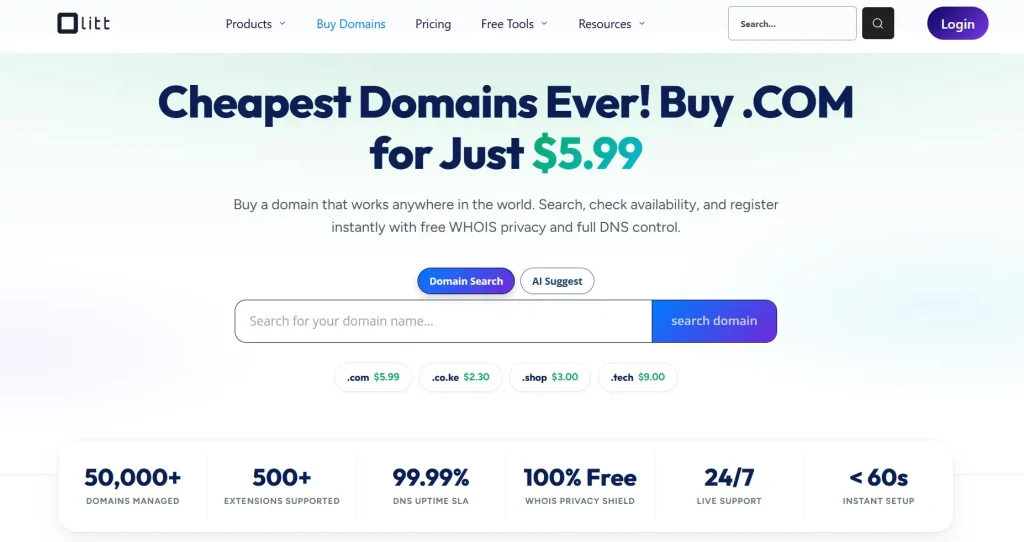
Through Olitt’s domain search tool, standard .com registrations start at an affordable rate for the first year, with renewal pricing shown upfront so there are no surprises later.
Premium or previously owned names can cost significantly more, sometimes reaching into the thousands, depending on how desirable the name is to buyers.
How to Register Your .com Domain
Getting started takes just a few steps.
- Search your desired name through Olitt to check availability
- Compare it against alternative extensions if your first choice is taken
- Complete payment, and your DNS settings configure automatically
- Connect your domain to a website or hosting account
Most registrations activate within minutes, so you can move straight into building your site.
Build Your Site on Your New .com Domain
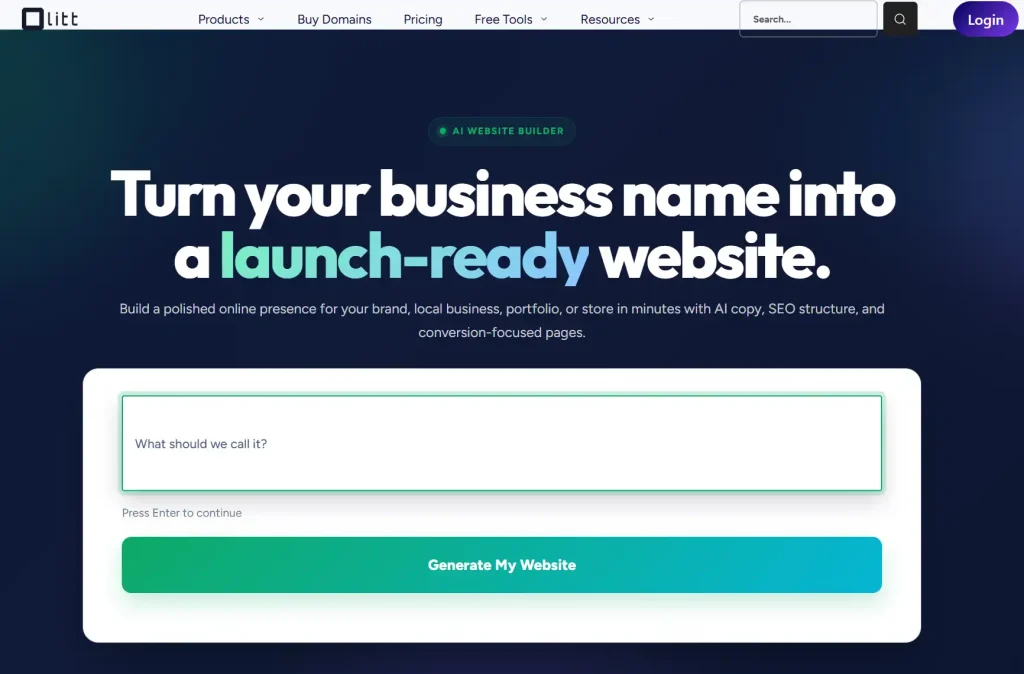
Once your domain is secured, pairing it with the Olitt AI website builder lets you describe your business and get a working draft site within minutes.
If you want the basics on domains more broadly before deciding, our guide on what a domain name actually is covers the essentials in simple terms.
Claim Your .com Domain With Olitt
The .com domain meaning traces back to commercial use, but today it has become the universal default for businesses, creators, and brands of every kind.
If your ideal name is still available, search and register it through Olitt’s domain page before someone else claims it.
Frequently Asked Questions
What does .com actually stand for?
It stands for commercial, reflecting its original purpose as an extension for business websites on the early internet.
Are there any restrictions on registering a .com domain?
No. Anyone, including individuals, businesses, and organizations, can register a .com domain without special qualifications.
Does a .com domain help my SEO?
Not directly. Search engines treat all domain extensions equally, though .com’s familiarity can support stronger click-through rates.
What should I do if my ideal .com name is taken?
You can try a variation, add a relevant word, or consider a strong alternative extension like .net, .co, or .io instead.
How much does a .com domain cost through Olitt?
Standard .com domains start at an affordable first-year rate through Olitt, with transparent renewal pricing shown before you buy.