Sarah bakes the best chocolate cake in Nairobi, and her customers keep asking for it.
They also keep asking the same other question. Do you have a website where I can order?
She would smile and say maybe someday, since the whole internet thing felt like learning a new language.
Then one afternoon, a customer mentioned she could not find Sarah’s Bakery online, and it hit her. Without a domain name, her business barely existed on the internet.
So she grabbed her phone and started searching, and this guide covers exactly what she learned.
What Is a Domain Name, Exactly?
A domain name is your website’s address on the internet.
Think of it like your home address, except it points people to your website instead of your front door.
When someone wants to visit your site, they type your domain name into their browser.
Google.com and Amazon.com are both domain names. They are what people remember and type whenever they want to reach a specific business online.
Without one, according to the ICANN glossary on domain names, a website is really just a hard-to-remember string of numbers.
Domain Name vs URL: What Is the Difference?
Sarah assumed these two terms meant the same thing, but they do not.
A domain name is just the main address, like sarahsbakery.com.
A URL is the full path, including everything after the domain, such as sarahsbakery.com/order-cake.
So every URL contains a domain name, but a domain name is only part of the full URL.
The Parts of a Domain Name
Every domain name is built from a few simple pieces.
- www – an older prefix that many sites still use, though it is optional today
- The name itself – your chosen word or phrase, like sarahsbakery
- The extension – the ending after the dot, such as .com or .org
Most visitors never think about these parts separately. They just work together as one address that leads to your site.
How Domain Names Actually Work
Sarah wondered how typing a few words into a browser could pull up the right website.
The answer is a system called DNS, short for Domain Name System.
Computers do not understand words. They communicate using number strings called IP addresses.
DNS acts like the internet’s phone book, translating a domain name into the correct IP address so your browser knows where to go.
From Typing to Loading, Step by Step
Here is what happens in the few seconds after you hit enter.
- You type a domain name into your browser
- Your computer asks a DNS server where that domain lives
- The server replies with the matching IP address
- Your browser connects to that address
- The website loads on your screen
All of this happens faster than a blink, which is part of why domain names exist in the first place. Nobody wants to memorize a string like 172.217.164.100 just to check email.
Domain Extensions and What They Mean
Picking an extension was Sarah’s first real decision, since there are so many options today.
| Extension | Best For | Global Appeal |
|---|---|---|
| .com | General business, commercial sites | Highest worldwide |
| .org | Nonprofits, causes, organizations | High trust factor |
| .net | Tech companies, networks, platforms | Moderate, growing |
| .co.ke | Kenya-based businesses | Strong local targeting |
| .io | Startups, developers, SaaS | Growing worldwide |
| .store | E-commerce shops | Niche but clear |
The .com extension remains the most recognized option worldwide, though good short names are getting harder to find.
Local extensions like .co.ke work well if your customers are mainly in one country, and Sarah considered this since most of her orders came from Nairobi.
If your business plans to grow past .com availability, our guide on alternatives to .com domain covers several strong options worth comparing.
Is a Domain Name the Same as Web Hosting?
Sarah assumed these were the same thing too, and it is a common mix-up.
A domain name is your address. Hosting is the storage space where your actual website files live.
You need both to have a working site, but they are two separate services, even when a provider sells them together.
Many beginners buy them separately and later regret the extra hassle of connecting two different dashboards, which is why bundled options can save real time.
Seven Tips for Picking Your Domain Name
Sarah wrote out a short checklist before deciding, and it is worth copying.
Keep it short. Aim for something under 15 characters if you can manage it.
Make it easy to spell. She almost chose a version with a hyphen and an apostrophe before realizing how confusing that would be to say out loud.
Skip numbers and hyphens. They cause confusion the moment you try to tell someone your website address out loud.
Think about keywords. A word related to your business can help visitors understand what you offer before they even click.
Check social media handles too. Sarah found a perfect domain name, then discovered the matching Instagram handle was already taken.
Plan for growth. She almost registered a city-specific name before realizing she might expand beyond Nairobi someday.
Protect your brand. She registered a couple of close variations of her main domain to prevent confusion later.
Common Domain Name Mistakes to Avoid
A few mistakes come up again and again among new business owners.
Picking a name too close to a competitor’s can send you their traffic, along with their confused or angry customers.
Choosing something overly clever can backfire too, since visitors may never guess what your business actually does from the name alone.
Skipping a trademark check is the riskiest mistake of all, since a name that infringes on an existing brand can lead to legal trouble down the road.
Where to Register Your Domain Name
Once Sarah had a shortlist of names, she needed somewhere to actually buy one.
Through Olitt’s domain search tool, she could check availability instantly and see pricing for popular extensions upfront, including .com and local options like .co.ke.
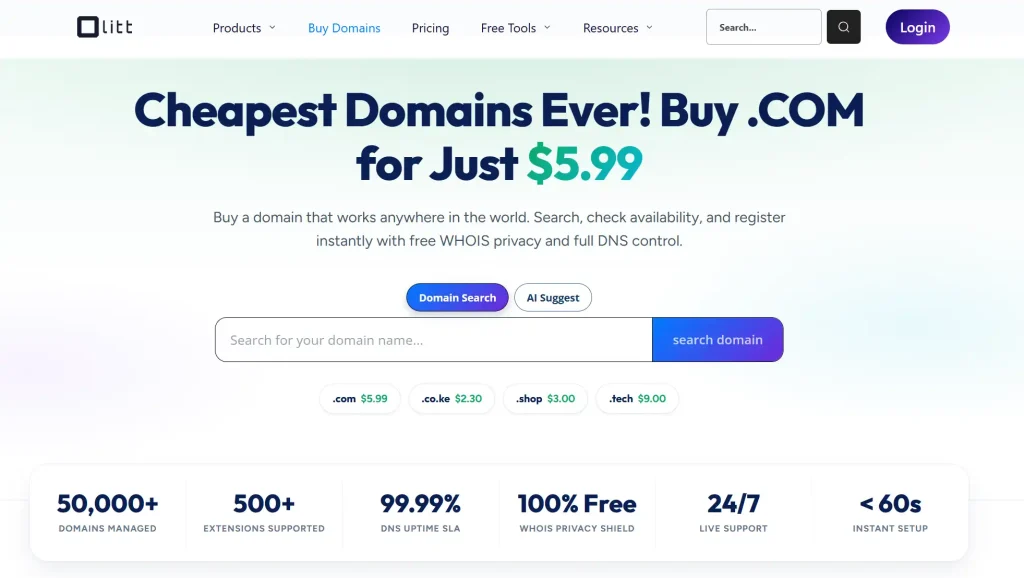
Registering a domain through Olitt also means privacy protection is included, so personal contact details stay out of public WHOIS records.
Because Olitt bundles domains with hosting and website tools on the same platform, Sarah could move from choosing a name to publishing a live site without switching between different providers.
If she had wanted a more tech-focused address instead, our breakdown of what a .net domain actually means explains when that extension makes sense too.
Once your domain is secured, pairing it with the Olitt AI website builder lets you describe your business and get a working draft site within minutes.
Domain Name Questions People Often Ask
u003cstrongu003eCan you change your domain name later?u003c/strongu003e
Technically yes, but it gets messy, since you can lose search rankings and confuse regular customers in the process.
u003cstrongu003eDo you own your domain name forever?u003c/strongu003e
Not exactly. You are renting it for a set period, usually one year, so missing a renewal means someone else can claim it.
u003cstrongu003eWhat happens if someone steals your domain name?u003c/strongu003e
It is rare, but enabling registrar lock and using a strong password are simple ways to prevent it.
u003cstrongu003eHow many domain names can you register?u003c/strongu003e
As many as you want. Larger companies often register several variations just to protect their brand name.
Sarah’s Domain Name Journey Ends
A few hours after she started searching, Sarah had her answer, and sarahsbakery.com was hers.
It felt like planting a flag. Her business finally existed online, and customers across Kenya could actually find her.
A domain name is more than a web address. It is your digital identity and often a customer’s first impression of your brand.
Register Your Domain With Olitt
Understanding what a domain name is matters far less than actually getting one before your ideal name is taken.
According to Cloudflare’s explainer on DNS, the domain system exists specifically to make the internet usable for people, not just machines, which is exactly why picking the right name is worth doing properly.
Start your search on Olitt’s domain page today, and take the first step toward putting your business online.